Introducing, Biblio.
Your one stop application for all your digital reading needs

Welcome to Biblio — a smarter way to read, understand, and stay consistent with your books.
On this page
The whole story, in five stops.
Why Biblio exists, what it can do, and where it goes next. Jump to any part, or just keep scrolling.
Why I built it
A friend recommended a book, so I grabbed the PDF and got ready to read. Then I hit a wall. I had nowhere to keep it, and nowhere to read it comfortably. The popular reading apps were cluttered, laggy, and looked years out of date.
When I looked into it, the bigger problem wasn't any one app. To read a single book properly, people use four: one to read it, one to track their progress, a dictionary for the words they don't know, and a notes app for the lines they want to keep. Every switch pulls you out of the book.
So I built one app that does all four jobs.
Read the full research →What it can do.
The short tour. Every tile links to its full page.
Reading
Read it your way.
When you upload a book on Biblio, you get all the control you need to make reading feel comfortable. Font size, type, themes, alignment, spacing, everything you want.
See the reader →
Library
Every book you own, in one place.
It can keep track of all your books, ones you own, ones you are reading, ones you wanna read, everything. One library for all your books, sorted into shelves you make yourself.
See the library →
Biblio AI
An AI that knows the book.
It explains words and phrases in the context of the book, so you really get the meaning behind the text. With circle to search, you can circle anything on the page, even a diagram, and ask about it.
See the AI →

Quote cards
Share the lines you love.
The feature I am most proud of. You can select any text from the book and turn it into a shareable quote, with lots of ways to customise it and plenty of themes.
See quote cards →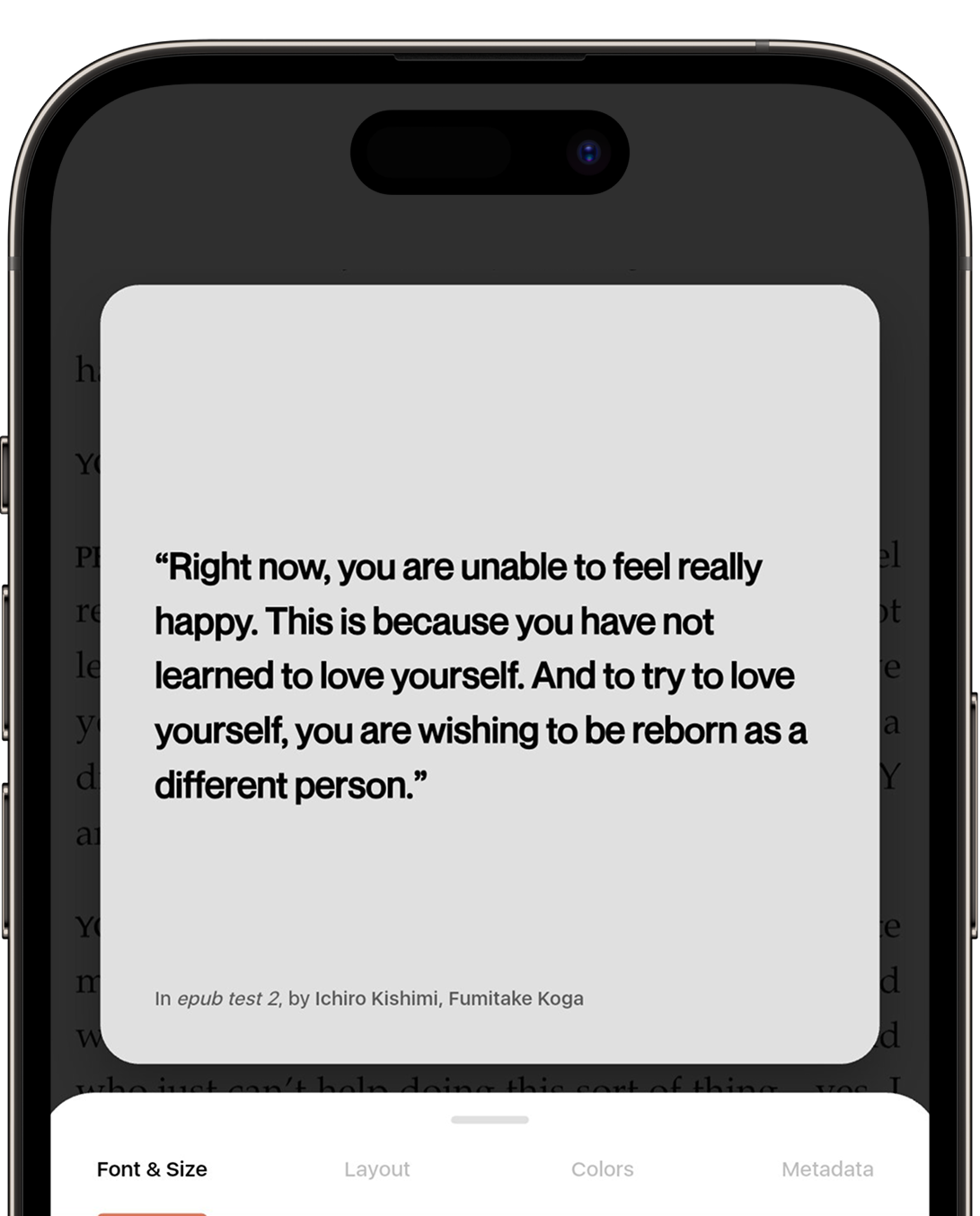
Book Journal
Everything you noticed, in one timeline.
Everything you highlight and every note you write goes into your Book Journal on its own. It's laid out like a timeline, so you can scroll back through what you were thinking while reading a book, or search it later.
See the journal →
Streaks
Come back every day.
The hard part of reading isn't starting a book, it's coming back to it every day. You set a daily goal (even 5 minutes is fine), and hitting it earns you XP and keeps your streak alive. Miss a day? Your first Streak Saver is free, after that it costs 100 XP, and it only works if you come back within 3 days.
See streaks →
Physical books
Paper books count too.
Start a reading session with a timer and turn on Focus Mode. The screen goes dark while Biblio counts the minutes, so paper reading counts towards your streak. Scan a line to save it as a quote, point your camera at something you don't get and ask the AI, or leave yourself a voice note.
See physical books →
And all of it syncs to your account, so a new phone doesn't mean losing your library, your streak or your notes.
What I think the market got wrong
Readers aren't short of apps.
ReadEra · 40M+
40M+
Good at: Light, offline reader
Missing: Streaks, stats, saving quotes, help with hard words
Moon+ Reader · 10M+
10M+
Good at: Endless settings
Missing: Cluttered; no habits, quotes or help in context
Librera · 10M+
10M+
Good at: Opens almost any file
Missing: No habits, notes or help
Bookly · 1M+
1M+
Good at: Reading habits and stats
Missing: Can't open a book; you log pages by hand
StoryGraph · 1M+
1M+
Good at: Tracking and recommendations
Missing: No reader, no quotes
Download figures from the Play Store.
People clearly want to read on their phones. What's missing is one place that holds the reading and the habit around it. Reader apps care about the book. Habit apps care about the behaviour. Nobody has joined the two.
That's also why Biblio is hard to copy. Bookly would have to build a reading engine from scratch. ReadEra would have to become a habit product, which is a different company. And because the reading happens inside Biblio, the tracking takes care of itself.
Why now
A couple of years ago, calling a language model every time someone long-pressed a word would have been too slow and too expensive for a free reading app. Now it's fast and cheap enough to do on every tap.


Where it stands today
I started building Biblio last year, with the tools I had back then. It works end to end, and the Android build is up on this site.
Looking at it now, with the AI tools I use today, I can see how much better it could be. A lot of the UI and UX was shaped by what I could build at the time, and there's a lot of room to make it smoother, simpler and nicer to spend time in.
That's where I'd start: the same idea, rebuilt with better tools and a sharper eye for the details.
What I'd build next
The features I've parked for the next version of Biblio.
01
A social feed
See what your friends are reading, the lines they're saving and how their streaks are going. Quote cards already make reading shareable; a feed gives them a home inside the app.
02
Book clubs
Read the same book with a group, at the same pace, and talk about it chapter by chapter without anyone spoiling what's next.
03
A book store
Find and buy your next book without leaving the app, so your library, your reading and whatever you read next all live in one place.
04
Streak widgets
A home-screen widget with your streak and today's goal. The easiest reminder to read is the one you see every time you unlock your phone.
05
Reading Wrapped
A yearly recap of your reading: books finished, hours read, your longest streak and your most-quoted lines. Made to be shared, the way Spotify Wrapped is.
06
Ask your library
Ask the AI about everything you've read and saved, not just the page you're on. "What did I highlight about habits?", answered across every book in your journal.
Thanks for reading.
The best way to judge Biblio is to use it.
Back to top ↑Note: The market analysis and competitive research presented on this site were conducted for educational and portfolio purposes to demonstrate product strategy and user experience design principles. All brand names and trademarks are the property of their respective owners.